
Tata Punch Specifications
₹5.75 Lakh to ₹10.77 Lakhex-showroom
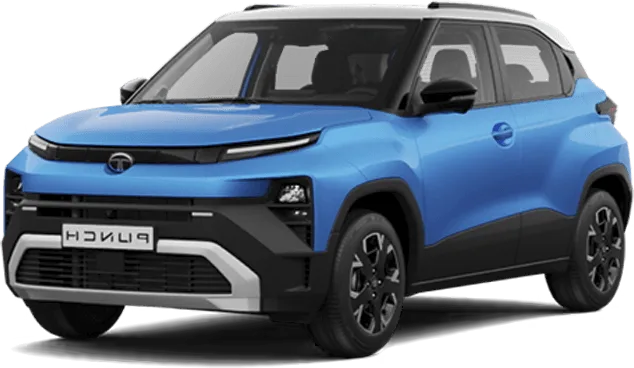
Showing the full spec sheet for the Smart Petrol MT. Features this variant does not get are marked NA.
- Engine
- 1.2L Revotron Petrol
- Displacement
- 1199 cc
- Max Power
- 87 bhp @ 6000 rpm
- Max Torque
- 115 Nm @ 3250 rpm
- Transmission
- 5-Speed Manual
- Drive Type
- Front Wheel Drive
- Fuel Type
- Petrol
Tata Punch power and torque explained
The Tata Punch gives you two engines, and both are 1.2 litre. One runs on petrol and makes 88 PS with 115 Nm. The other runs on factory CNG and makes 73 PS with 103 Nm, giving up some muscle for much cheaper running per kilometre.
Both engines hold their peak torque at 3300 rpm and their peak power at 6000 rpm. So neither pulls hard the instant you touch the pedal; a few extra revs is where each one wakes up. The petrol just has more in hand once it does.
How to read this chart. Torque is the push you feel when you accelerate, and it peaks low on the rev range. Power is how hard the engine keeps pulling as it revs higher, and it peaks further up. The two dots mark those peaks. The shaded strip between them is the flexibility band: a wider band pulls easily across more revs and feels relaxed in traffic, while a narrower band asks you to rev the engine more to get its best. Use the buttons above to compare this car's engines.
Peak figures come from the 1.2L Revotron iCNG spec sheet. The line between the two peaks is not a measured dyno curve.
The 1.2 petrol is the stronger engine. Its 115 Nm of torque arrives at 3300 rpm, and its 88 PS peak comes at 6000 rpm. That is a wide 2700 rpm spread, so it keeps pulling as you rev on towards the top. Choose it if your days mix city traffic with the odd highway run, you often carry the whole family, and you want overtakes to feel relaxed. It is worth seeing what a petrol Punch works out to on the road in your city once you have picked your trim.
The 1.2 CNG shares those same rev points, just with softer figures: 103 Nm at 3300 rpm and 73 PS at 6000 rpm, over the same 2700 rpm span. With less on tap, it feels more relaxed than urgent, and that shows most on a climb or with the car fully loaded. It fits you if most of your driving is city commuting and low running cost per kilometre matters more than quick pace. If you are torn between the two, the complete look at the Punch shows how each engine suits a different kind of driver.