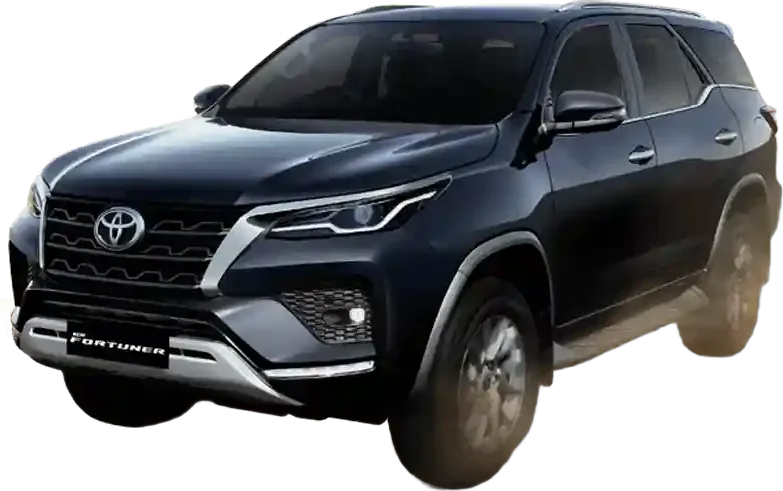
The Toyota Fortuner specifications really describe two very different SUVs. One is a road-biased petrol, the other a torquey diesel workhorse. Reading the sheet with your use in mind matters here.
The 2.7 litre petrol makes 163.6 bhp and suits low-distance city buyers. The 2.8 litre diesel steps up to 201 bhp with 420 to 500 Nm of torque. That torque is what lets the Fortuner tow, climb and cruise without strain. The petrol suits calm city use, the diesel long highway hauls.
Gearboxes run to a six speed manual and a six speed automatic, both on the diesel. Rear wheel drive keeps costs down, while four wheel drive adds real trail ability. A 48V Neo Drive mild hybrid tops the diesel automatic for smoother stop-start. That mild hybrid adds a small electric boost when pulling away.
On fuel, the petrol returns 10.3 kmpl and the diesels sit between 14.2 and 14.6 kmpl. Those diesel figures are decent for a heavy body-on-frame SUV. See which drivetrain returns the best Fortuner mileage before you choose. The 80 litre tank gives a long highway range. Approach and departure angles back up the off-road claim on the 4x4 trims.
The Fortuner measures 4795 mm long with a 2745 mm wheelbase and seats seven. The 296 litre boot grows a lot once you fold the third row. The tall body means a slightly firm, upright ride around town. Safety kit covers multiple airbags, stability control and hill assist. To match your budget, check the Fortuner price in your city.