
Hyundai Bayon Specifications
₹9.99 Lakh to ₹17.99 Lakhex-showroom
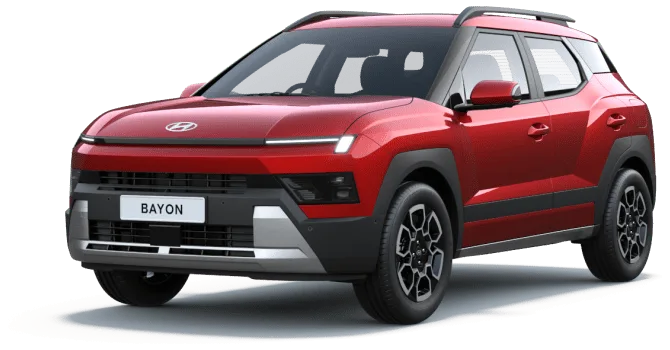
Showing the full spec sheet for the HX2. Features this variant does not get are marked NA.
- Engine
- 1.5L MPi Petrol
- Displacement
- 1497 cc
- Max Power
- 115 PS (113 bhp) @ 6300 rpm
- Max Torque
- 143.8 Nm @ 4500 rpm
- Transmission
- 6-Speed Manual
- Drive Type
- Front Wheel Drive
- Fuel Type
- Petrol
Hyundai Bayon power and torque explained
The Bayon has one engine, a 1.5 litre four cylinder petrol with no turbo. You can pair it with a 6 speed manual on any trim, or with the IVT automatic from the HX5 up.
Without a turbo, its pull builds steadily as the revs rise instead of arriving in one early rush. That suits relaxed daily driving, and the IVT adds Dash Boost for the moments when you need a quick overtake.
How to read this chart. Torque is the push you feel when you accelerate, and it peaks low on the rev range. Power is how hard the engine keeps pulling as it revs higher, and it peaks further up. The two dots mark those peaks. The shaded strip between them is the flexibility band: a wider band pulls easily across more revs and feels relaxed in traffic, while a narrower band asks you to rev the engine more to get its best.
Peak figures come from the 1.5L MPi Petrol spec sheet. The line between the two peaks is not a measured dyno curve.
The 1.5 petrol makes its peak 143.8 Nm at 4500 rpm and its full 115 PS at 6300 rpm. Both peaks sit high in the rev range, just 1800 rpm apart, so the engine gives its best in the upper half of the rev band. At low city speeds it feels easy going rather than punchy. On the highway, drop a gear before you pass, or let the IVT's Dash Boost and Sport mode do the work. It suits a family that drives mostly in town with regular highway trips, so check the Bayon versions with the IVT before you choose a gearbox.