
Maruti Suzuki Fronx Specifications
₹6.90 Lakh to ₹12.03 Lakhex-showroom
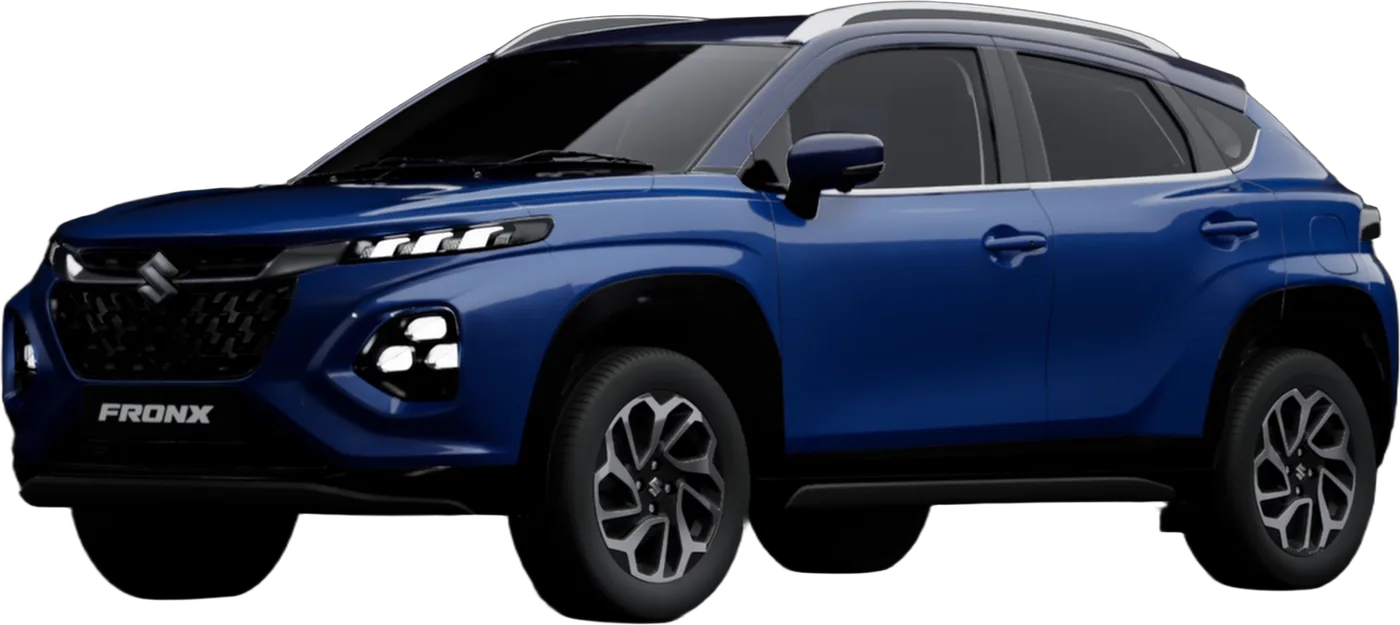
Showing the full spec sheet for the Sigma. Features this variant does not get are marked NA.
- Engine
- 1.2L K-Series DualJet Petrol
- Displacement
- 1197 cc
- Max Power
- 88.5 bhp @ 6000 rpm
- Max Torque
- 113 Nm @ 4400 rpm
- Transmission
- 5-Speed Manual
- Drive Type
- Front Wheel Drive
- Fuel Type
- Petrol
Maruti Suzuki Fronx power and torque explained
The Maruti Fronx gives you three engines to weigh up. There is a 1.2 litre petrol, a factory fitted 1.2 litre CNG that runs on gas, and a peppy 1.0 litre Boosterjet turbo petrol.
The two 1.2 litre engines make their torque high up, so they feel happiest when you rev them through town. The little turbo is the odd one out, pulling hard from low revs and holding that pull far longer.
How to read this chart. Torque is the push you feel when you accelerate, and it peaks low on the rev range. Power is how hard the engine keeps pulling as it revs higher, and it peaks further up. The two dots mark those peaks. The shaded strip between them is the flexibility band: a wider band pulls easily across more revs and feels relaxed in traffic, while a narrower band asks you to rev the engine more to get its best. Use the buttons above to compare this car's engines.
Peak figures come from the 1.2L K-Series DualJet S-CNG spec sheet. The line between the two peaks is not a measured dyno curve.
The 1.2 litre CNG is the one to pick if low running cost is your main goal. On gas it makes 77 PS at 6000 rpm and 98.5 Nm of torque, and that torque peaks fairly high at 4300 rpm. So it does its best work when you rev it, rather than pulling hard the moment you set off. That suits steady city commuting more than a loaded highway climb or a quick overtake. If you drive a lot and want the cheapest kilometre, it helps to know how far the Fronx stretches each kilo of CNG before you commit.
The 1.2 litre petrol is the simple, smooth choice for everyday driving. It lifts power to 90 PS at 6000 rpm and puts out 113 Nm, with that torque arriving high at 4400 rpm. Only 1600 rpm separates its two peaks, the tightest spread of the three, so its best pull sits up in the higher revs. Keep it spinning and it feels willing for town runs and the odd dash on the highway. Pick this one if you want a fuss free petrol and do not need the extra shove of the turbo.
The 1.0 litre Boosterjet turbo is the strong one, with the most power and the most torque in the range. It gives its full 147.6 Nm from just 2000 rpm and holds every bit of it to 4500 rpm, a broad and flat band of pull. So the shove is there the moment you press on, whether you are slipping past a truck or climbing a ghat with the car full. Peak power of 100 PS lands at 5500 rpm, leaving a wide 3500 rpm between the two peaks. So you seldom need to change down for a quick burst of speed. Pick the turbo if you drive on the highway often or want the easiest overtakes. To land on the right trim, see which Fronx versions carry this Boosterjet engine.