
Maruti Suzuki S-Presso Specifications
₹3.50 Lakh to ₹5.27 Lakhex-showroom
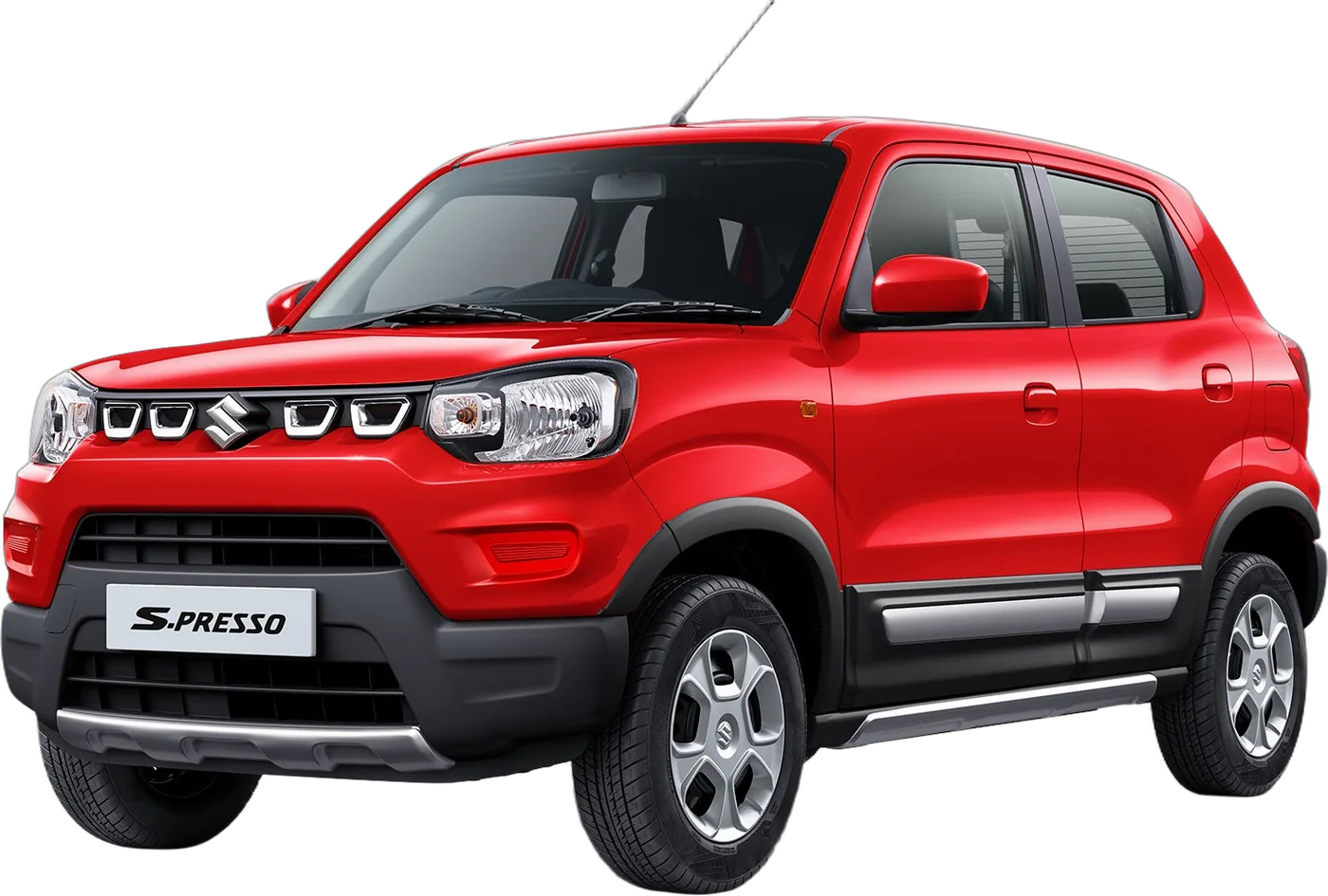
Showing the full spec sheet for the Std (O). Features this variant does not get are marked NA.
- Engine
- 1.0L K10C Petrol
- Displacement
- 998 cc
- Max Power
- 68 bhp @ 5600 rpm
- Max Torque
- 91.1 Nm @ 3400 rpm
- Transmission
- 5-Speed Manual
- Drive Type
- Front Wheel Drive
- Emission Norm
- BS6
- Fuel Type
- Petrol
Maruti Suzuki S-Presso power and torque explained
Your S-Presso can run on petrol or on factory fitted CNG, and both use the same 1.0 litre K10C engine. Petrol gives more, at 69 PS (68 bhp) and 91.1 Nm. CNG gives 57 PS (56 bhp) and 82.1 Nm. Only the petrol offers an AGS automatic.
How to read this chart. Torque is the push you feel when you accelerate, and it peaks low on the rev range. Power is how hard the engine keeps pulling as it revs higher, and it peaks further up. The two dots mark those peaks. The shaded strip between them is the flexibility band: a wider band pulls easily across more revs and feels relaxed in traffic, while a narrower band asks you to rev the engine more to get its best. Use the buttons above to compare this car's engines.
Peak figures come from the 1.0L K10C S-CNG spec sheet. The line between the two peaks is not a measured dyno curve.
On petrol, the torque peak lands at 3400 rpm and the power peak at 5600 rpm, 2200 rpm apart. That gives you a broad range in each gear, so stop and go traffic needs fewer gear changes. The S-Presso is small and light, so 69 PS is enough for a highway trip now and then. Maruti rates it at 24.12 km/l on the Std (O) and LXi (O), 24.76 km/l on the other manuals and 25.30 km/l with the AGS. Before you settle on a trim, check its on-road price.
The CNG has its torque peak at the same 3400 rpm, with the power peak earlier at 5300 rpm. With less of both, it is best for short town trips at an easy pace. On a hill or with the car full, drop a gear and keep the revs up. It seats four, not five, and is rated at 32.73 km/kg. Since low running cost is the reason to buy it, see how far a kilo of CNG takes the S-Presso.