
Renault Duster Hybrid Specifications
₹16.99 Lakh to ₹19.69 Lakhex-showroom
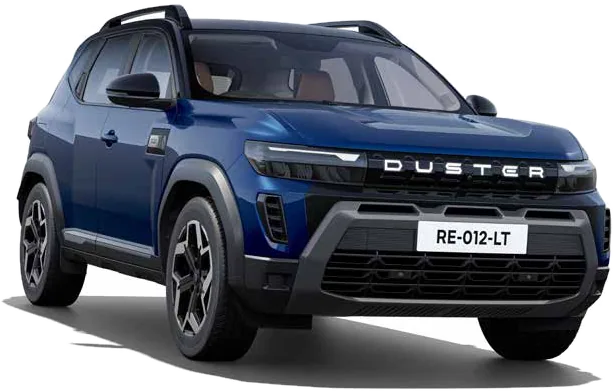
Showing the full spec sheet for the Evolution E-Tech. Features this variant does not get are marked NA.
- Engine
- 1.8L E-Tech 160 Strong Hybrid Petrol
- Displacement
- 1789 cc
- Max Power
- 160 PS system (engine 110 PS @ 5300 to 5800 rpm + traction motor 50 PS)
- Max Torque
- 175 Nm @ 3000 rpm (engine) + 208 Nm (motor)
- Transmission
- Multi-mode Automatic (2 electric + 4 petrol gears)
- Drive Type
- Front Wheel Drive
- Fuel Type
- Hybrid
Renault Duster Hybrid power and torque explained
The Duster Hybrid pairs a 1789 cc four cylinder petrol with two electric motors and a 1.4 kWh battery that charges itself. Together they make 160 PS through a multi-mode automatic with two electric and four petrol gears.
How to read this chart. Torque is the push you feel when you accelerate, and it peaks low on the rev range. Power is how hard the engine keeps pulling as it revs higher, and it peaks further up. The two dots mark those peaks. The shaded strip between them is the flexibility band: a wider band pulls easily across more revs and feels relaxed in traffic, while a narrower band asks you to rev the engine more to get its best.
Peak figures come from the 1.8L E-Tech 160 Strong Hybrid Petrol spec sheet. The line between the two peaks is not a measured dyno curve.
The petrol engine makes 110 PS from 5300 to 5800 rpm and 175 Nm at 3000 rpm, while the traction motor adds 50 PS and 208 Nm from a standstill. In the city the motor does much of the work, and Renault says the car can run on electric power for up to 80 percent of the time. On the highway the engine takes over, and Renault quotes 0 to 100 km/h in 9.61 seconds and a certified 29 kmpl.