
Maruti Suzuki's Q2 Profit Falls 27% on Commodity Costs and Investment Losses
Record volumes lifted net sales 26.1%, but commodity costs tied to the West Asia conflict and mark-to-market losses cut profit. The full numbers and what drove them.

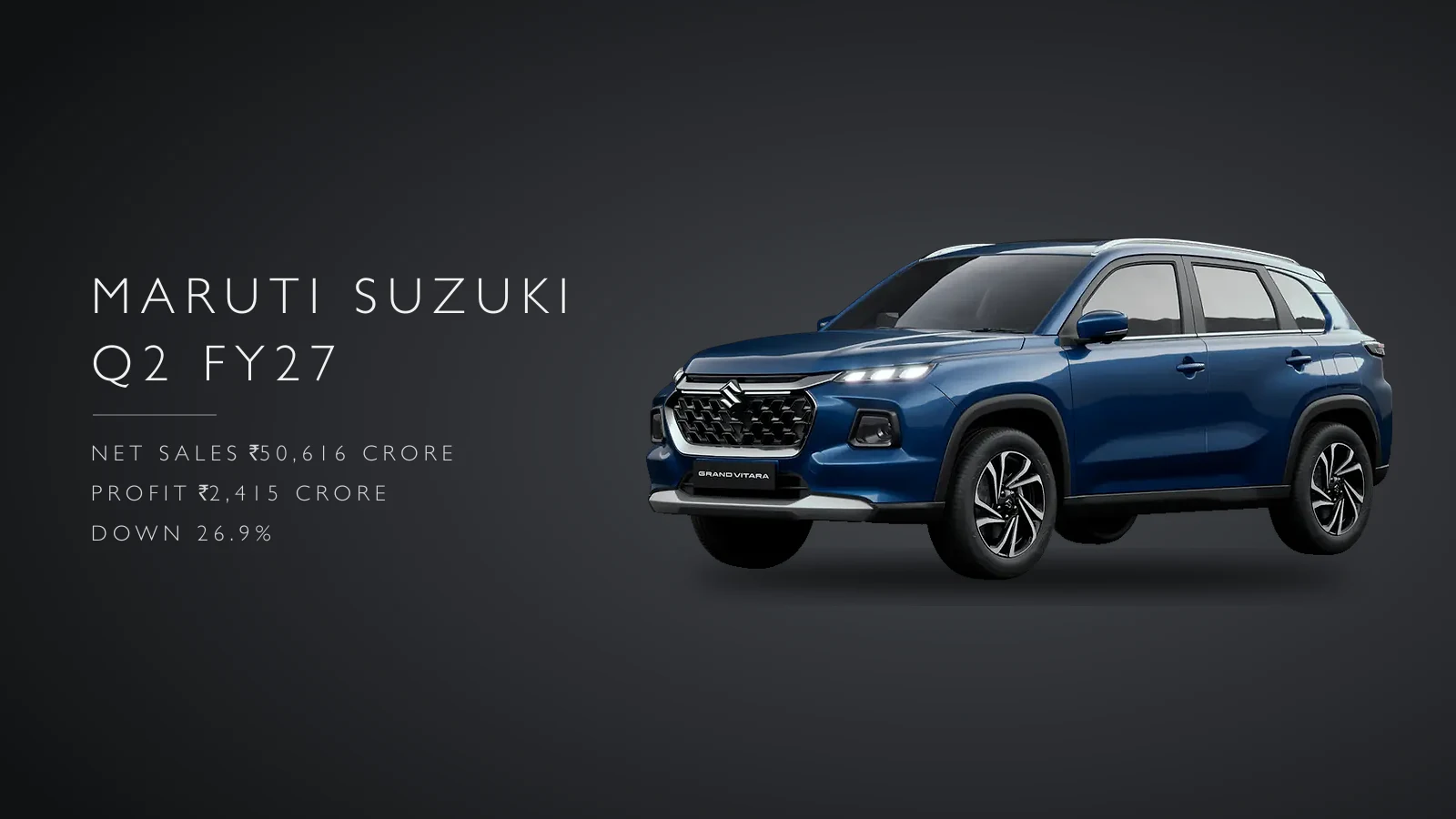
Maruti Suzuki's net profit fell 26.9% to ₹2,414.9 crore in July to September 2026, even though the carmaker posted record quarterly net sales and vehicle sales.
Net sales rose 26.1% to ₹50,615.5 crore from ₹40,135.8 crore a year earlier, the company said on 27 October. Net profit for July to September 2025 had been ₹3,302.8 crore.
Maruti gave two reasons for the fall. Commodity prices pushed up by the West Asia conflict cut its operating profit, and losses on its invested cash reduced its other income.
The Numbers
| Figure | Q2 FY27 | Q1 FY27 | Q2 FY26 | Year on year |
|---|---|---|---|---|
| Vehicles sold | 6,96,654 | 6,82,724 | 5,50,874 | Up 26.5% |
| Net sales | 50,615.5 | 49,959.1 | 40,135.8 | Up 26.1% |
| Operating profit (EBIT) | 2,803.7 | Not reported | 3,382.0 | Down 17.1% |
| Net profit | 2,414.9 | 3,352.1 | 3,302.8 | Down 26.9% |
Operating profit came to 5.5% of net sales, against 8.4% a year earlier, by DynoBHP's calculation from the reported figures.
Maruti's figures include Suzuki Motor Gujarat, which merged into the company from 1 December 2025. Earlier periods have been restated so the quarters can be compared.
Where the Profit Went
The cost pressure began in April to June. Maruti said in July that material costs had started rising in that quarter and were "seriously aggravated during the war".
Operating profit then rose 10.8% on the previous quarter. Net profit moved the other way, falling 28% from ₹3,352.1 crore.
The gap came below the operating line. Maruti said its non-operating income fell sharply because of mark-to-market losses on its invested surplus.
A mark-to-market loss records a drop in the market value of investments the company still holds. No sale is needed for it to reach the profit figure.
Maruti has now cited these losses for a fall in profit in two of the three quarters of 2026. In January to March, its net profit fell 6.9% to ₹3,590.5 crore, which it put down mainly to mark-to-market impact.
Record Volumes Behind the Revenue
The 6,96,654 vehicles Maruti sold in the quarter were the most it has sold in a quarter. Sales in India grew faster than exports, which slipped to 1,08,119 units from 1,10,487 a year earlier.
Maruti put its domestic market share at 40.8%, up 2.2 percentage points from a year earlier. It said about 2,00,000 bookings were still pending at the end of September.
Its monthly sales releases show the fastest growth in utility vehicles, a group that includes the Grand Vitara, Fronx and Ertiga.
A Centre Named After Osamu Suzuki
The board also approved a Section 8 company, the legal form used for not-for-profit ventures in India, to set up a centre of excellence named after Osamu Suzuki.
The centre will teach Japanese manufacturing methods and Osamu Suzuki's ideas to build technical skills across Indian manufacturing. Maruti will run it as part of its corporate social responsibility work.
The board said Osamu Suzuki "put his trust in India" and transformed the country's car industry over more than four decades.